
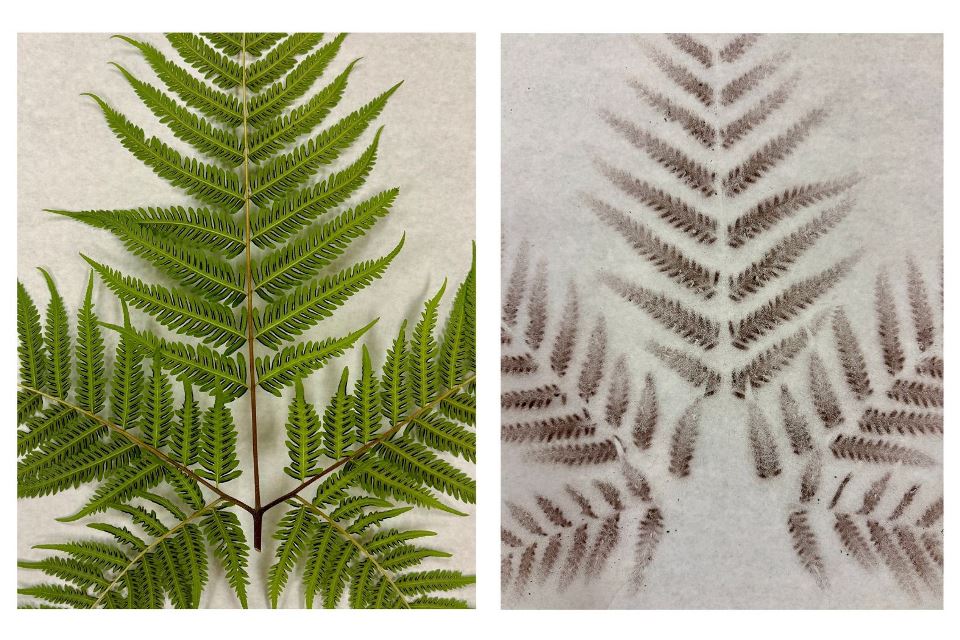
If you’ve ever wandered through a fern-filled garden or hiked on a summer afternoon and watched dust shimmer in the golden light, you may have witnessed ferns in the act of reproduction. Appearing in fossil records dating back about 350 million years, ferns evolved long before flowering and seed-producing plants and even predate the earliest known dinosaurs. Fittingly, their reproductive cycle differs greatly from that of seed-producing plants. Rather than producing flowers and seeds, ferns reproduce via spores. In the Pacific Northwest, summer is peak season for spore development. By August, most ferns have finished pushing their seasonal growth, including the fertile fronds responsible for releasing spores. Brushing past ferns at the height of spore production can produce a cloud of the finest “dust,” sending this precious genetic material on its way to new destinations.
So, what exactly distinguishes a seed from a spore?
Spores appear as a fine, velvety powder, but each one is a tiny, single-celled reproductive structure containing genetic material. In ferns, spores are produced in specialized structures on or beneath a frond and can remain dormant until conditions are favorable for germination. A seed, by contrast, contains a fertilized embryo, along with stored food and a protective coating. In seed-producing plants, fertilization follows pollination; a spore is neither pollinated nor does it contain an embryo. These tiny reproductive cells come in many shapes, sizes, and arrangements: flattened disks, slender lines, and shades of green, gold, black, brown, and red. Compare the undersides of several fern fronds, and you’ll find that spore-bearing structures can be nearly as distinctive as the ferns themselves.
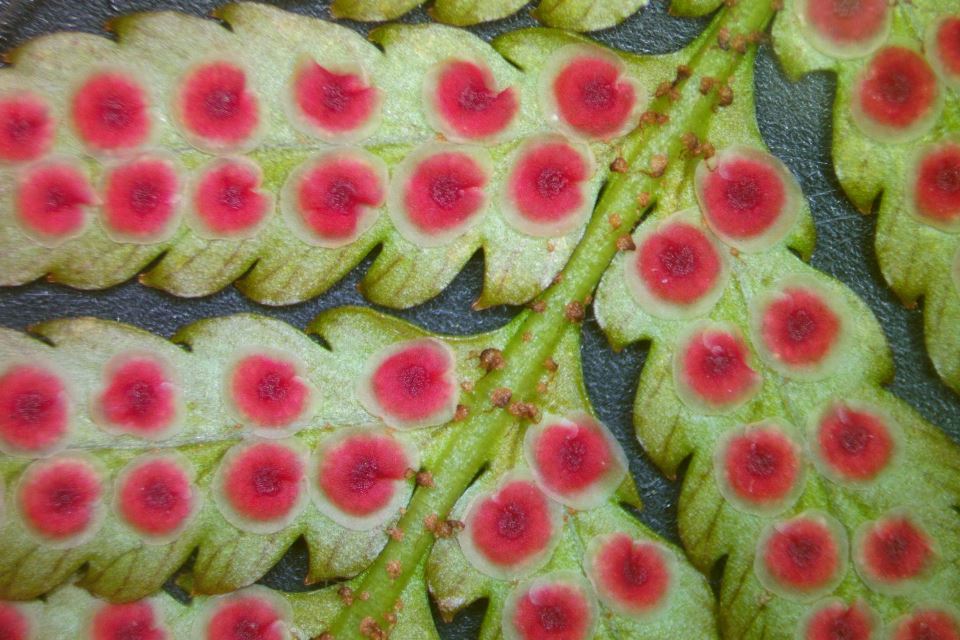
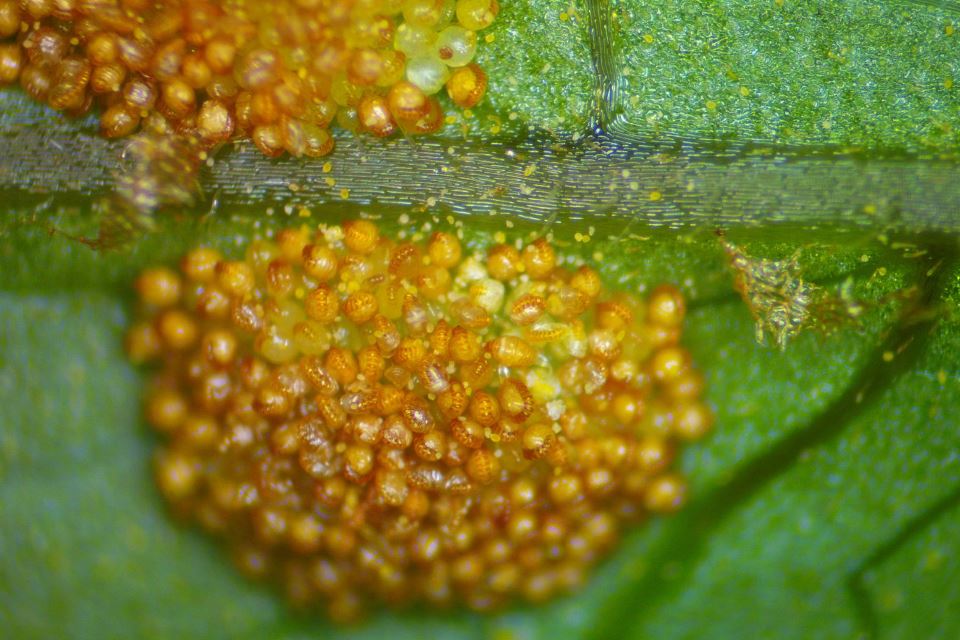
Sori with red indusia on Dryopteris erythrosora (left), Exindusiate sporangia (naked sori) of Drynaria (right)
What are you seeing on the underside of a fern frond?
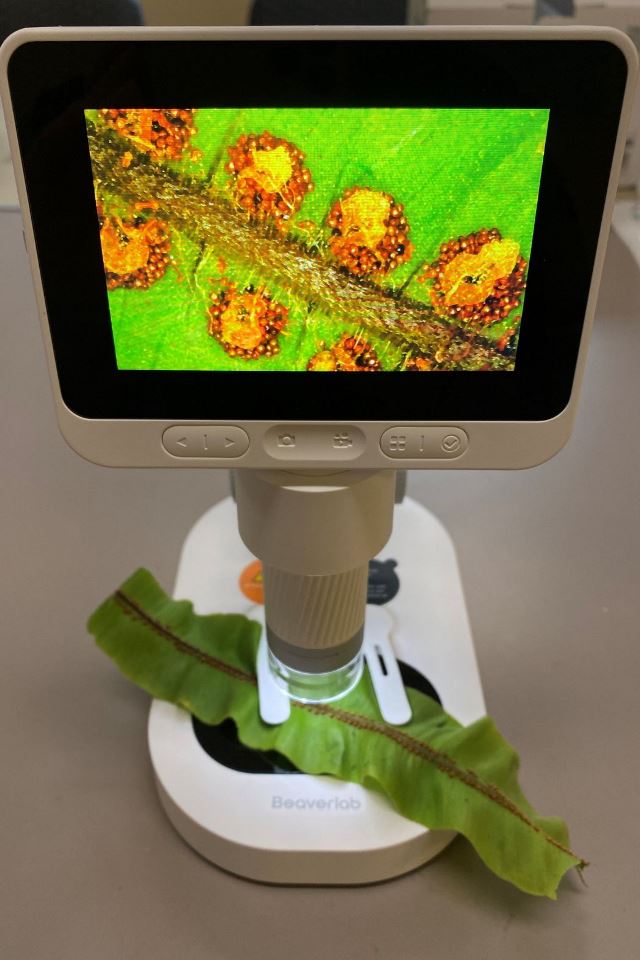
Spores develop inside structures called sporangia, and a cluster of sporangia is called a sorus (plural: sori). Sori are visible to the naked eye, but individual spores are much smaller and are best viewed under a microscope. In some ferns, a cap-like protective layer called an indusium covers each sorus, while others have no indusium. Botanists often use the shape, size, color, and arrangement of sori and indusia to identify fern species. For example, ferns in the genus Dryopteris typically have kidney-shaped indusia covering the sori on the undersides of their fronds, while Polystichum species have round indusia attached at the center of the sori, like tiny umbrellas. Most sori can be seen by simply turning over a frond, but some ferns produce separate and distinctly different fertile fronds. Our native deer fern, Blechnum spicant (now Struthiopteris spicant), sends up thin, contorted, rigidly upright fertile fronds devoted solely to producing spores.
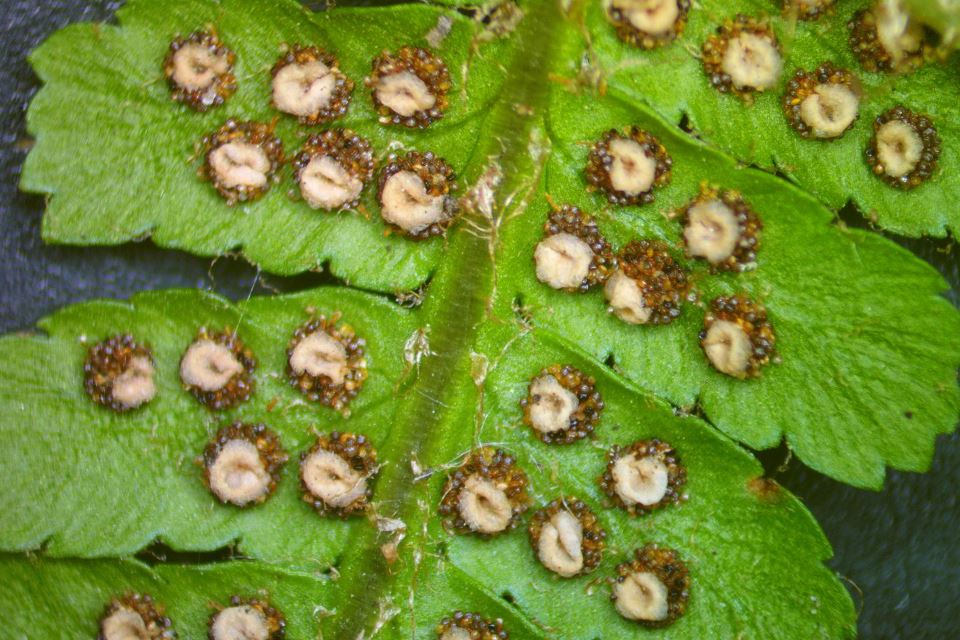
Polystichum munitum sori (left), Sporangia ready to release spore on a Dryopteris species (right)
Then, how does the fern life cycle differ from that of flowering plants?
Unlike angiosperms and gymnosperms (the seed-producing plant groups), ferns reproduce through a two-stage life cycle called the alternation of generations. Each of the multicellular stages plays an essential role in the life of a fern. When conditions are favorable, spores released from a sorus germinate and form a structure called a prothallus, the gametophyte phase of the life cycle. This first structure bears little resemblance to the mature fern and instead appears like a velvety green moss or liverwort across the soil. During this phase, the gametophyte develops male and female reproductive structures that produce sperm and eggs. In the presence of water, sperm swim to an egg and fertilization occurs, beginning the second generation in the cycle, known as the sporophyte stage. The young sporophyte eventually produces the true fronds of a mature fern, and in time, produces spores of its own, thus completing the cycle.
However, in botany there are almost always exceptions to the rules. Some ferns are capable of apogamy, a reproductive process in which the sporophyte develops directly from the gametophyte without egg fertilization. Apogamy occurs in a variety of fern species and is particularly associated with ferns growing under stressful environmental conditions, including dry habitats. By allowing a fern to bypass the need for fertilization, this adaptation can provide an alternative means of reproduction when conditions are unfavorable for the typical life cycle.
If all the fern-specific terminology feels overwhelming, remember that ferns were here first, long before flowering plants and certainly long before humans began differentiating and naming these complex systems. Exploring the intricacies of ferns takes us back in time and provides a look into the evolutionary lineage of plants. Doesn’t this make the seemingly mysterious language of ferns worth learning?
References:
Li, F.-W., & Suissa, J. S. (2026). Ferns: Lessons in Survival from Earth’s Most Adaptable Plants. Hardie Grant North America.
Olsen, S. (2007). Encyclopedia of Garden Ferns. Timber Press.
Download PDF: BLOG_Glorious Spores_Emily Joseph_Aug 2026