
Download Early Summer_2012 Self Tour
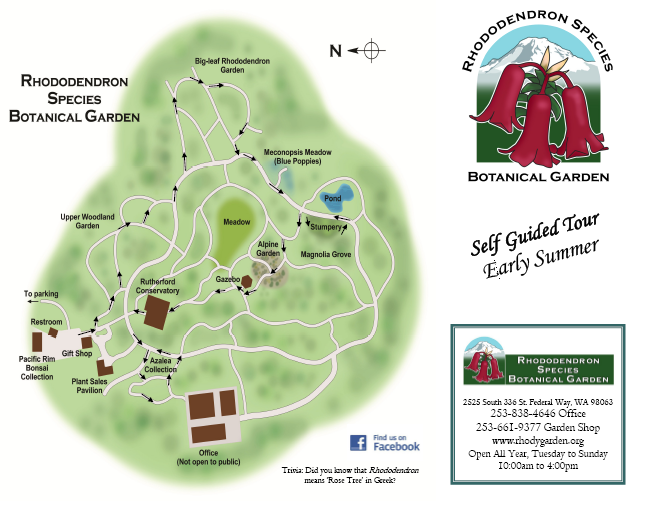
From the Garden Shop, stay to your left and follow the sign and walk to the Upper Woodland Garden which fea-tures many species with thickly indumented leaf under-surfaces. Take the path between the two deciduous mag-nolia trees. The magnolia on your right is #1 Magnolia sargentiana var. robusta from China. This pink flowering magnolia has among the largest flowers of any magnolia. This plant is fairly uncommon in cultivation despite the large flowers and nice foliage. The one on your left is #2 Magnolia hypoleuca from Japan. Its cup-shaped creamy white flowers appear in June and its huge leaves grow up to one and a half feet long!
Walk farther along the path and you will see various kinds of woodland groundcovers including :
#3 Luzula sylvatica (Golden Wood Rush)
#4 Gymnocarpium (Oak Fern)
#5 Ajuga (Bugleweed)
#6 Speirantha convallarioides (False Lily of the Valley)*
#7 Coptis laciniata, Goldthread*
#8 Primula moupinensis*
These groundcovers are suitable for shady woodland gar-dens. #7 Coptis laciniata is a slow-spreading groundcover and native to the Pacific Northwest. The name comes from the golden yellow rhizomes that creep just beneath the surface of the ground. The last in the list, #8 Primula moupinensis, is a very interesting and rare primrose from S. Sichuan, China. What makes it interesting is it sends numerous runners just like strawberries. Pale pink flowers are produced in early spring.
Let’s walk back to the main path and make a left turn. Pass the bamboo on your right and walk on to the narrow path on your left. This area is called the Big Leaf Garden. Most of the big-leafed rhododendrons eventually become very large trees in their native temperate rainforests in the Sino-Himalaya. Notice the beautiful new growth of #9 Rhododendron hodgsonii native to the eastern Himalayan Mountains. The new foliage emerges with shiny silvery indumentums, and the smooth and exfoliating older stems are also attractive. On your left, you will see #10 Acer palmatum ‘Red Pygmy’. Notice the reddish-maroon foliage that maintains its color all summer long.
Continue straight ahead to a large patch of #11 Podo-phyllum pleianthum*, the Asian May Apple. This is a beautiful woodland plant with umbrella-like foliage. The plant is used medicinally in its native China. Across form the May Apple is #12 Acer palmatum ‘Emerald Lace’. The very finely-dissected leaves open yellow-green, turn a deep-green in summer and change to bright burgundy in fall.
You should now be veering slightly to the right and headed toward the main path. Stay to the left and see #13 Rhododendron rex* on both sides. This plant has extremely attractive shiny deep green foliage with a thick gray to buff indumentums beneath. In China, where it grows wild, it can attain heights of up to 45 feet. On your left, see #14 Arisaema consan-guineum, Jack in the Pulpit. This is a fantastic and unusual woodland plant that is easily grown in a shaded garden.
Go back to the main path and take a left. On your left, you will see #15 Primula secundiflora*. Look closely and notice the calyx with vertical stripes. This species is native to China. Keep walking and you will see #16 Lilium hansonii on your right. The reflexed petals of the bright yellow-orange flowers are very thick in texture. It’s native to Korea and Japan. This lily was grown from seed collected wild in Japan. Across from the lilies is #17 the Meconopsis meadow planted with hundreds of Himalayan Blue Poppies* just finish-ing blooming. #18 Cardiocrinum giganteum, the Him-alayan Giant Lily from China can grow to 12 feet tall with masses of six inch long fragrant flowers in June. This plant is monocarpic, which means it dies after flowering.
Keep going along the main path until you see the Hardy Fern Foundation’s Victorian Stumpery (#19) on your right. A Stumpery is an English Victorian pe-riod garden design that romanticizes nature. The de-sign uses tree roots and stumps placed on their sides or upside down creating a “Wild Scene” which is then planted with thousands of ferns and other woodland plants. Have a seat on the cut cedar-log bench at the
top of the Stumpery and enjoy the view of the pond garden.
From the stumpery, walk back along the main path toward the blue poppies and take an immediate up-hill left at the dwarf Japanese maple. Go up the hill and you will see #20 Rhododendron pachysanthum on your left. This is one of the finest foliage plants in the genus Rhododendron. Indumentum color ranges from silver-white to rich brown on the upper surface. It’s native to Taiwan. Up the hill is the Alpine Gar-den (#21). Please take some time to explore this unique garden area. Most of the plants here are found at high altitudes in the mountains of Asia. Don’t miss the beautiful specimen of #22 Rhododen-dron campylogynum*. Walk up toward the Gazebo for a break and the fine view.
Follow the signs for the self-guided tour which will take you past #23 Stewartia pseudocamellia, a sum-mer-flowering tree with beautiful bark. This camellia relative also has colorful fall foliage. Continue straight ahead to the Rutherford Conservatory (a separate self-guided handout to tour the Rutherford Conservatory is available inside).
From the front door of the conservatory, head back to the main path and go left to visit #24 Azalea gar-den. The mass plantings of #25 Primula prolifera and #26 Iris sibrica ‘Caesar’s Brother’ is a stunning color combination. Also, don’t miss the bloom of #27 Rho-dodendron calendulaceum*, the Flame Azalea which is native to the Appalachian Mountains of the Eastern USA where it occurs in forests and rocky openings.
From here, you can walk back to the garden shop where you started. Many of the plants you viewed today are available in the sales area. Most of these plants are rare in retail nurseries. We hope you en-joyed the self guided tour today. Please come back and visit the garden again.
* For sale at the RSBG Nursery